Android Developers, Don’t Reset Your Career. Expand It.
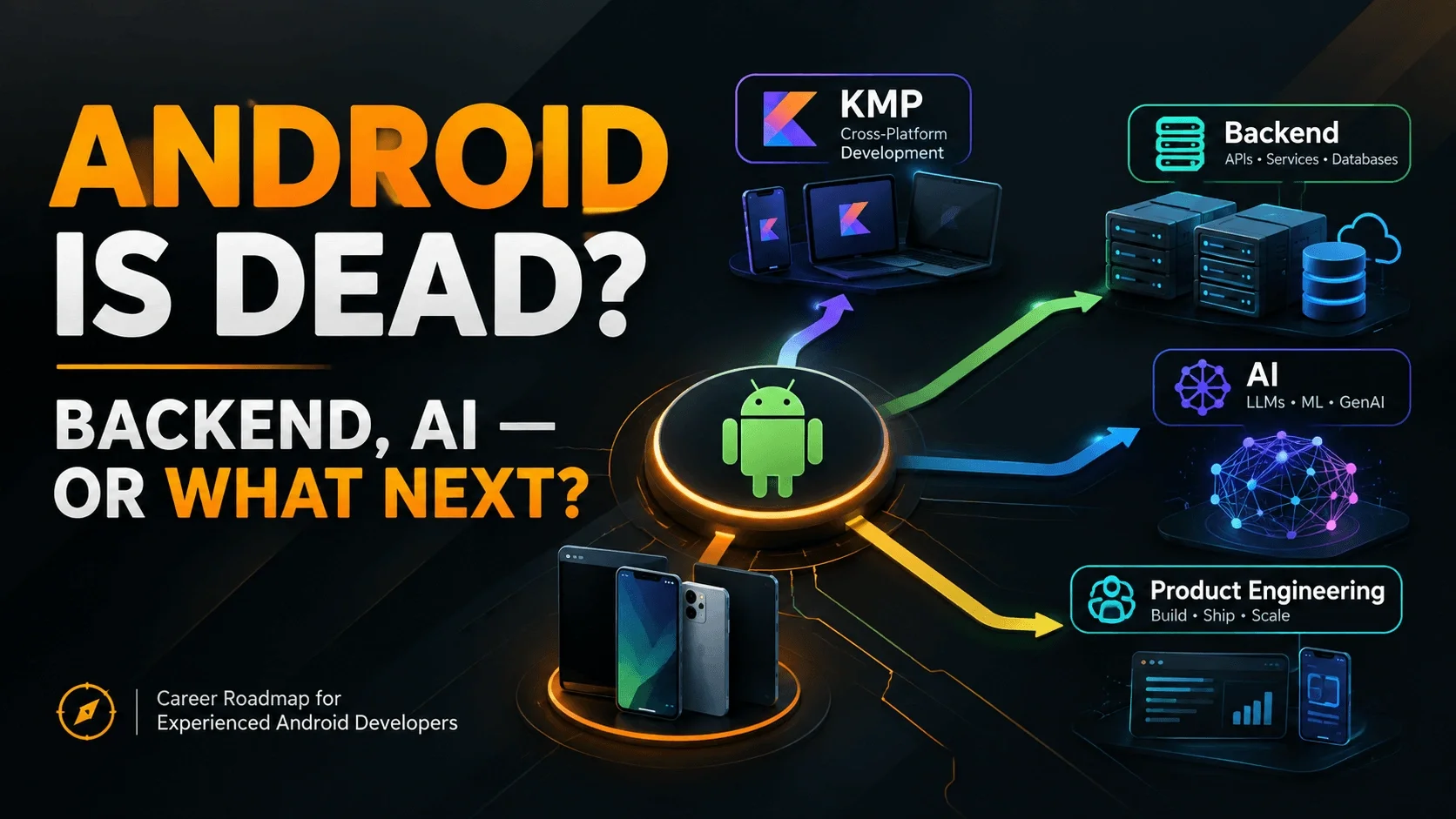
If you’re an Android developer and confused about what to learn next, read this.
I’ve been hearing the same question from experienced Android developers who were recently laid off:
“Android openings are getting fewer. Should I move to backend? Should I learn AI? What has a future?”
This question is especially common among developers with 8, 10, or 13+ years of experience.
My advice is simple:
Don’t throw away your biggest advantage just because the market is more competitive.
The market is not necessarily disappearing. The competition is higher, companies are becoming more selective, and experienced engineers are competing for fewer high-quality opportunities.
That requires a better strategy—not a complete career reset.
First priority after a layoff: get a job
Let’s be practical.
After a layoff, your first priority should be to get back into the job market. Your first priority should not be to spend a year switching domains because everyone is talking about backend or AI.
If you have spent 8–13 years building Android applications, your fastest path to employment is usually through the experience you already have.
Use your existing advantage first:
Apply for Senior Android Engineer roles.
Explore Staff Mobile Engineer positions.
Look at Mobile Platform and Android Architecture roles.
Consider Kotlin Multiplatform opportunities.
Target product companies where mobile ownership matters.
Use referrals instead of depending only on online applications.
Then add adjacent skills that increase your opportunities.
A domain switch can be the right decision, but it should not be a panic reaction. If you switch from Android to backend immediately, you may have to compete as someone with limited backend experience despite having more than a decade of engineering experience.
That is an expensive reset.
The real problem is not only fewer openings
Many developers say:
“Android jobs are gone.”
But in many cases, the bigger problem is that the hiring bar has increased.
Companies want fewer specialists who only implement screens. They want engineers who can understand the complete product:
Mobile architecture.
Backend APIs.
Data and storage.
Security.
Performance.
Observability.
Product metrics.
AI integration.
Cross-platform strategy.
Business trade-offs.
This does not mean Android is no longer valuable.
It means the definition of a valuable Android engineer is changing.
Instead of being only a feature implementer, become someone who can own a product from the mobile client to the production system.
The career formula
For an experienced Android developer, a strong growth path looks like this:
Android depth + KMP + system design + backend + AI
This does not mean you must master everything in a few months.
It means you should build a profile where your existing experience remains the foundation and new skills expand the kinds of problems you can solve.
1. Go Deeper Into Android
At junior and mid-level positions, Android knowledge is often evaluated through framework APIs, UI implementation, and feature development.
At senior and staff levels, the discussion is different.
You may be expected to explain:
How would you design an offline-first application?
How does synchronization work when the device goes offline?
How would you improve startup time?
How do you reduce battery consumption?
How should background work be scheduled?
How would you design local storage and caching?
How do you handle pagination and unreliable networks?
How do you protect sensitive data?
How do you manage a large multi-module project?
How do you debug production-only crashes?
What trade-offs did you make in your architecture?
System design is not only about APIs, databases, and caching.
For mobile engineers, system design also includes:
App lifecycle.
Offline support.
Data synchronization.
Background execution.
Networking.
Storage.
Performance.
Security.
Build systems.
Release management.
Production monitoring.
A developer with deep Android expertise and strong engineering judgment is still valuable. But that value must be visible in interviews and in the way you present your work.
Build Real Android Depth
If you want to strengthen these areas in a structured, practical way, join the Android Job-Ready Bootcamp.
The program is designed for Android developers who want to move beyond basic feature development and prepare for senior-level interviews, architecture discussions, and real-world engineering challenges.
Many professional Android developers have already joined the program to improve their Android fundamentals, system-design knowledge, project understanding, and interview confidence.
Learn more about the Android Job-Ready Bootcamp:
Join the Android Job-Ready Bootcamp
Don’t just learn how to build Android screens. Learn how to design, scale, debug, secure, and confidently explain production-ready Android systems.
2. Learn Kotlin Multiplatform properly
Kotlin Multiplatform is becoming an important option for Kotlin and Android engineers who want to work across platforms.
KMP allows teams to share code across Android, iOS, desktop, web, and server while retaining the ability to use native platform capabilities. Google officially supports KMP for sharing business logic between Android and iOS.[kotlinlang][developer.android]
But KMP is not a keyword to add to your resume after completing one tutorial.
Many developers write “KMP” on their profile, wait for a call, and then struggle when the interviewer asks practical questions.
You should understand:
What code should be shared.
What code should remain platform-specific.
How to structure common and platform modules.
How to handle platform-specific implementations.
How Kotlin interoperates with Swift.
How to expose coroutines and flows to iOS.
How to test shared business logic.
How to handle networking and serialization.
How to manage local storage.
How to design offline synchronization.
How to configure builds and dependencies.
How to debug Android and iOS integration issues.
How to migrate an existing Android application gradually.
Business logic, domain models, networking, caching, and state management are common candidates for sharing, while platform-specific UI and APIs may remain native depending on the product and team structure.[kotlinlang][kotlinlang]
The important question is not:
“Can you create a KMP project?”
The important question is:
“Can you make a sensible architectural decision about what should and should not be shared?”
That is where experienced Android engineers can stand out.
3. Add backend without abandoning Android
You do not need to become a backend specialist overnight.
You need enough backend knowledge to design and build products end to end.
Start with:
REST APIs.
Authentication and authorization.
PostgreSQL.
Data modeling.
Caching.
Background jobs.
Queues.
File storage.
Rate limiting.
Docker.
Basic cloud deployment.
Logging and monitoring.
Choose one backend stack and build something real.
If you want to remain close to Kotlin, learn Kotlin with Ktor or Spring Boot. If you want faster experimentation with AI products, Python with FastAPI is also practical.
The technology is less important than understanding the concepts:
Where should business logic live?
How should the API handle failure?
How do you protect user data?
How do you prevent duplicate requests?
How do you handle retries?
What happens when the database is unavailable?
How do you scale a slow endpoint?
How do you monitor production issues?
Backend should increase your ability to solve product problems. It should not become another collection of technologies on your resume.
4. Learn AI application development, not AI buzzwords
AI is important, but “learning AI” is too vague.
You do not necessarily need to become a machine-learning researcher. For most Android and product engineers, the immediate opportunity is AI application development.
Learn:
LLM APIs.
Structured output.
Prompt design.
Streaming responses.
Function and tool calling.
Retrieval-augmented generation.
Embeddings and vector search.
Agent workflows.
Evaluation and reliability.
Cost and latency management.
Privacy and security.
On-device AI.
Android developers can integrate Gemini-powered capabilities through Firebase AI Logic, which provides access to generative AI models and mobile-focused integrations.[firebase.google][firebase.google]
But remember:
Calling an AI API is not the same as building an AI product.
A real AI product still needs:
A useful user problem.
Good interaction design.
Reliable data.
Authentication.
Backend controls.
Cost management.
Error handling.
Analytics.
Privacy.
A way to measure whether the feature actually helps users.
Everyone is saying “AI, AI, AI.”
Your advantage will come from understanding where AI genuinely improves the product.
5. Build one real product
Do not build ten unfinished demos.
Build one product using:
KMP + backend + AI
For example, you could build an AI learning application that:
Runs on Android and iOS.
Shares domain logic through KMP.
Uses a backend for authentication and user progress.
Uses AI to generate practice questions and explanations.
Stores learning history.
Works with limited connectivity.
Tracks retention and engagement.
Includes a paid plan.
This one project can become:
Your portfolio.
Your GitHub showcase.
Your interview discussion.
Your system-design example.
Your technical content series.
Your consulting demonstration.
Potentially, your own business.
Do not build a project only to show that you know a framework.
Build something that demonstrates judgment.
Be ready to explain:
Why you selected the architecture.
What you shared through KMP.
What stayed native and why.
Where AI was used.
How you secured the system.
How you handled offline behavior.
How you controlled AI costs.
How you would scale it.
What you would change in the next version.
The positioning shift
Instead of saying:
“I’m an Android developer looking for an Android job.”
Position yourself as:
“I’m a senior Kotlin and mobile engineer who can design and build AI-powered products across platforms.”
This does not mean hiding your Android identity.
It means showing that your Android experience is the foundation of a wider product-engineering capability.
Your resume should highlight:
Systems you owned.
Technical decisions you made.
Scale and complexity.
Performance improvements.
Business impact.
Cross-functional collaboration.
Mentoring and leadership.
Production incidents you resolved.
Products you delivered from idea to release.
Your years of experience should communicate ownership—not only the number of screens you built.
A realistic learning order
Do not try to learn Android, KMP, backend, AI, cloud, DevOps, and system design simultaneously.
Use this order:
First: job readiness
Prepare for the roles you can target today:
Kotlin.
Android architecture.
Coroutines and Flow.
Jetpack Compose.
Performance.
Testing.
Debugging.
System design.
Behavioral interviews.
Second: KMP
Learn KMP deeply enough to build and explain a real shared module.
Third: backend fundamentals
Learn APIs, PostgreSQL, authentication, caching, deployment, and monitoring.
Fourth: AI product development
Build one useful AI feature and understand its limitations, cost, privacy, and reliability.
Fifth: long-term positioning
Move toward Staff Mobile Engineer, Mobile Platform Engineer, AI Product Engineer, or full product-engineering roles.
What you should not do
Do not learn backend because someone told you Android is dead.
Do not learn AI because everyone on social media is using the word.
Do not add KMP to your resume after watching a two-hour tutorial.
Do not wait for interview calls before preparing.
Do not spend six months learning without applying.
Do not start from zero if you already have a decade of valuable experience.
Most importantly, do not confuse collecting technologies with becoming more employable.
A recruiter does not hire a list of keywords. A company hires someone who can solve important problems with reasonable quality, speed, and judgment.
The advantage you already have
Your years of Android experience are not obsolete.
You already understand:
How real users interact with software.
How mobile constraints affect architecture.
How apps fail in production.
How to work with unreliable networks.
How to ship through app stores.
How to debug devices you cannot physically access.
How to balance product requirements with technical limitations.
How to maintain software over time.
A beginner learning AI or backend does not automatically have these skills.
Do not throw them away.
Add to them.
Final message
The goal is not to become an Android developer, KMP developer, backend developer, and AI developer separately.
The goal is to become an engineer who can solve a larger class of product problems.
So if you have 8, 10, or 13+ years of Android experience:
Do not reset your career.
Do not follow every trend blindly.
Do not wait passively for calls.
Do not use keywords without depth.
Do not abandon your strongest advantage.
Go deeper into Android.
Learn KMP properly.
Add backend fundamentals.
Understand AI application development.
Build one real product.
Then present yourself not as someone desperately searching for any job, but as an experienced engineer who can create more value across the product lifecycle.
Don’t learn backend because Android is dead.
Don’t learn AI because everyone is talking about AI.
Learn them because they increase the surface area of problems you can solve.
Your career does not need a reset.
It needs an expansion.
Comments (0)
No comments yet. Be the first to share your thoughts!
Leave a Comment
Get the latest updates
Join our newsletter and never miss an article.