Manegerial Round - Android Development
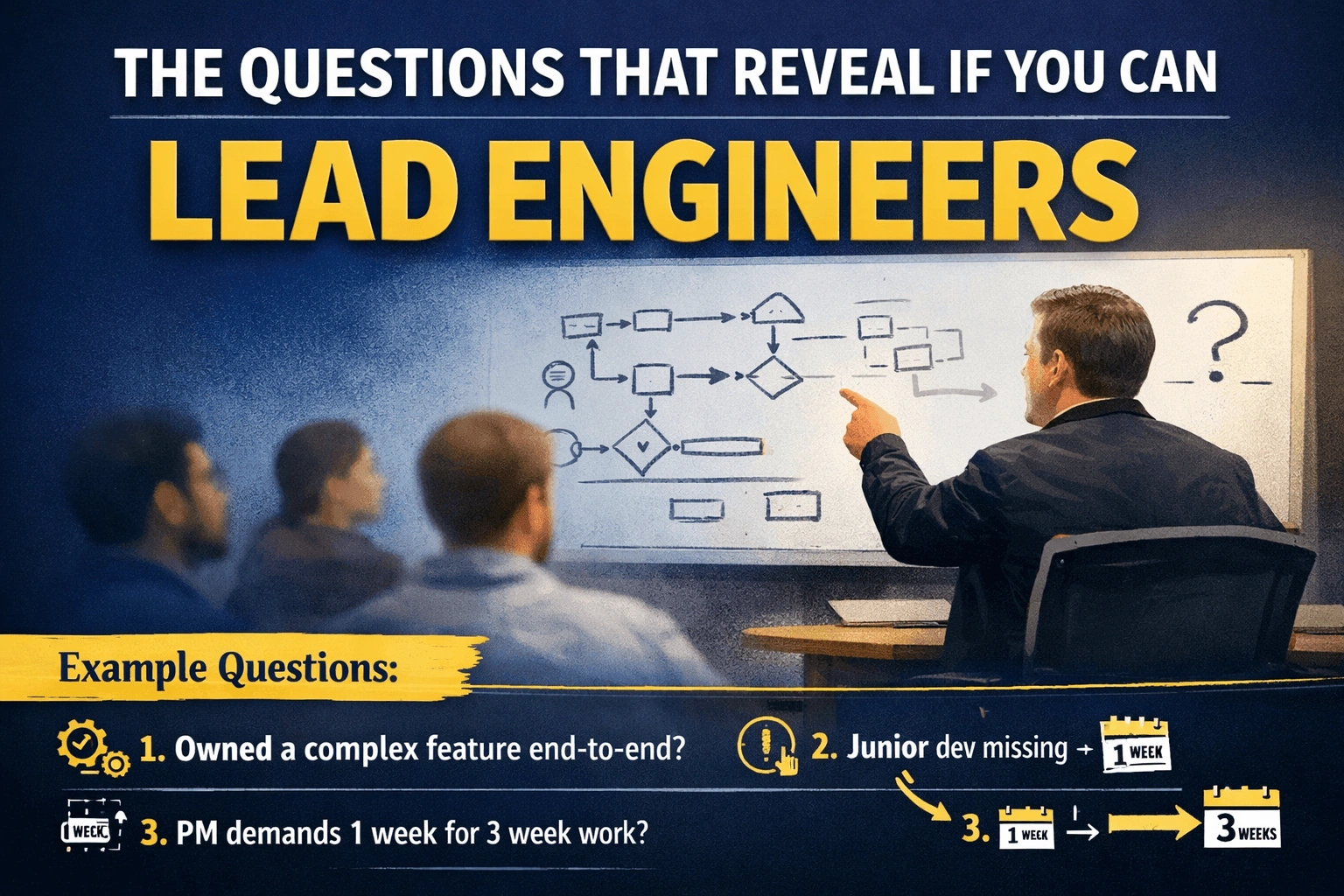
The Questions That Reveal Whether You Can Actually Lead Engineers
Engineering manager interviews aren't about how well you code anymore. They're about how you think, communicate, own outcomes — and grow the people around you.
There's a particular moment in every engineering manager interview where the conversation shifts. The whiteboard questions are done, the system design has been sketched out, and then the interviewer leans back and says: "Tell me about a time when..."
This is where most candidates lose the role — not because they lack experience, but because they don't understand what's actually being measured. These aren't questions about what happened. They're questions about how you think, how you lead, and whether you're someone an engineering team can genuinely trust when things get hard.
Here are six of the most revealing managerial interview questions, what they're really testing, and how to answer them in a way that shows you're ready to lead.
1. "Tell me about a technically complex feature you owned end to end."
What they're really asking: Can you operate at the intersection of technical depth and delivery ownership — without hiding behind your team when things go wrong?
This question is about ownership, not just involvement. Interviewers are listening for the word "I" — not in a way that erases your team, but in a way that signals you took genuine accountability for outcomes.
A strong answer walks through how you shaped the technical approach, what trade-offs you made and why, how you unblocked your team, and what the feature actually delivered for the business. Weak answers describe the project as a team effort from start to finish without a single moment of personal decision-making.
How to answer it well: Use a project where you made at least one consequential technical decision — an architecture call, a build-vs-buy judgment, a deliberate descoping. Name the decision, explain the reasoning, and say what happened. The goal is to show that ownership means being the last person who can say "I decided this, and here's why."
2. "How do you handle a junior developer who's consistently missing deadlines?"
What they're really asking: Do you lead with empathy and accountability — or do you skip to blame?
This is one of the most mishandled questions in engineering manager interviews. Candidates either jump to performance management language (which signals they don't coach) or they over-explain a compassionate approach with no accountability attached (which signals they avoid hard conversations).
The right answer holds both truths at once: something is getting in this person's way, and it's my job to find out what — and then to be clear about what needs to change.
How to answer it well: Describe a real conversation structure. First, you make it private and non-accusatory. Second, you get curious — are the deadlines realistic? Is there a skill gap, a tooling problem, a personal situation? Third, you align on a clear, shared expectation going forward. And fourth, you follow through. Show the interviewer that you can be both warm and direct — that you're not choosing between being a good manager and being an honest one.
3. "A PM wants a feature in one week that genuinely needs three. What do you do?"
What they're really asking: Can you negotiate without being dismissive — and can you protect your team without being obstructionist?
This is a scoping and communication question disguised as a timeline question. The interviewer isn't looking for "I push back on the PM." They're looking for evidence that you can have a productive, structured conversation about trade-offs — one that makes the PM feel heard while being honest about what's actually possible.
The worst answers are extremes: either you cave ("okay, we'll figure it out") or you dig in ("three weeks, non-negotiable"). Both signal an inability to collaborate across functions.
How to answer it well: Walk through your process. You start by understanding why one week — is there a launch event? A customer commitment? A revenue dependency? Then you explore what's actually needed for that deadline versus what's nice-to-have. Can a subset of the feature ship in a week and still deliver meaningful value? What are the risks of rushing versus waiting? Frame it as a joint problem-solving conversation, not a negotiation you need to win.
4. "How do you run code reviews on your team?"
What they're really asking: Do you use code reviews as a quality gate, or as a mentoring tool? And do you have opinions about craft?
This question is deceptively casual, but it reveals a lot. Engineers who've never thought about code review philosophy treat it as a checkbox. Engineering managers who understand leverage treat it as one of the highest-ROI rituals on the team.
A strong answer has three layers: what you look for in reviews, how you give feedback, and how you use the process to develop junior engineers. It also signals your values — do you care more about consistency, about catching bugs, about knowledge sharing, or about performance?
How to answer it well: Describe your rubric clearly. Explain the difference between blocking and non-blocking comments on your team. Talk about how you try to ask questions rather than issue commands — "Have you considered X?" instead of "Change this to X." And mention how you deliberately use code reviews to transfer context and build the skills of people who are earlier in their careers. That last part is what separates a manager answer from an engineer answer.
5. "Tell me about a technical decision you made that turned out to be wrong."
What they're really asking: Are you self-aware enough to own your mistakes — and mature enough to learn from them instead of defending them?
This is a trap question, but only if you treat it that way. Candidates who can't find a genuine example signal either a lack of experience or an inability to reflect. Candidates who find an example but spend most of the answer explaining why it wasn't really their fault signal defensiveness.
The interviewer wants to see a clean arc: you made a decision, you saw the consequences, you understood why your reasoning was flawed, and you did something differently afterward. That's it.
How to answer it well: Pick something real and specific — not a catastrophic failure, but something concrete enough to be credible. A premature optimization. A library choice that created long-term maintenance pain. An architecture that didn't scale the way you anticipated. Explain your reasoning at the time without making it sound like obvious negligence. Then describe what changed in how you approach similar decisions. The best answers end with a principle — something you now apply that you didn't before.
6. "How do you keep up with Android ecosystem changes?"
What they're really asking: Are you still technically curious — or did you stop growing when you stopped coding full-time?
For any platform-specific engineering manager role, this question tests whether you've maintained genuine interest in the craft even as your day-to-day moved away from writing code. A manager who can't speak intelligently about what's happening in their domain loses credibility with senior engineers fast.
But it also tests something subtler: are you the kind of person who learns proactively, or only reactively? Do you stay current because you're curious, or only when a team member forces the conversation?
How to answer it well: Be specific. Name the Android developer blogs you actually read. Mention the Google I/O sessions you found interesting this year. Reference a recent Jetpack Compose update or a behavioral change in Android 15 that your team had to account for. Show that your learning is active, not passive. And if you can connect it to how you brought that knowledge to your team — by sharing a relevant article in Slack, or running a lunch-and-learn — even better. It shows you multiply your own learning rather than just accumulating it.
The Pattern Across All Six
If you look at these questions together, a clear pattern emerges. Every one of them is probing for the same underlying quality: the ability to hold complexity without collapsing it.
Complexity in delivery. Complexity in human relationships. Complexity in technical trade-offs. Complexity in your own judgment and where it's fallen short. The questions that reveal great engineering managers are the ones that reveal whether you can sit with that complexity — and still make a decision, still have a hard conversation, still take accountability, still keep learning.
The candidates who answer these questions well aren't the ones with the most polished answers. They're the ones who are clearly telling the truth.
Comments (0)
No comments yet. Be the first to share your thoughts!
Leave a Comment
Get the latest updates
Join our newsletter and never miss an article.