Full-Stack Web Developer Roadmap (2026)
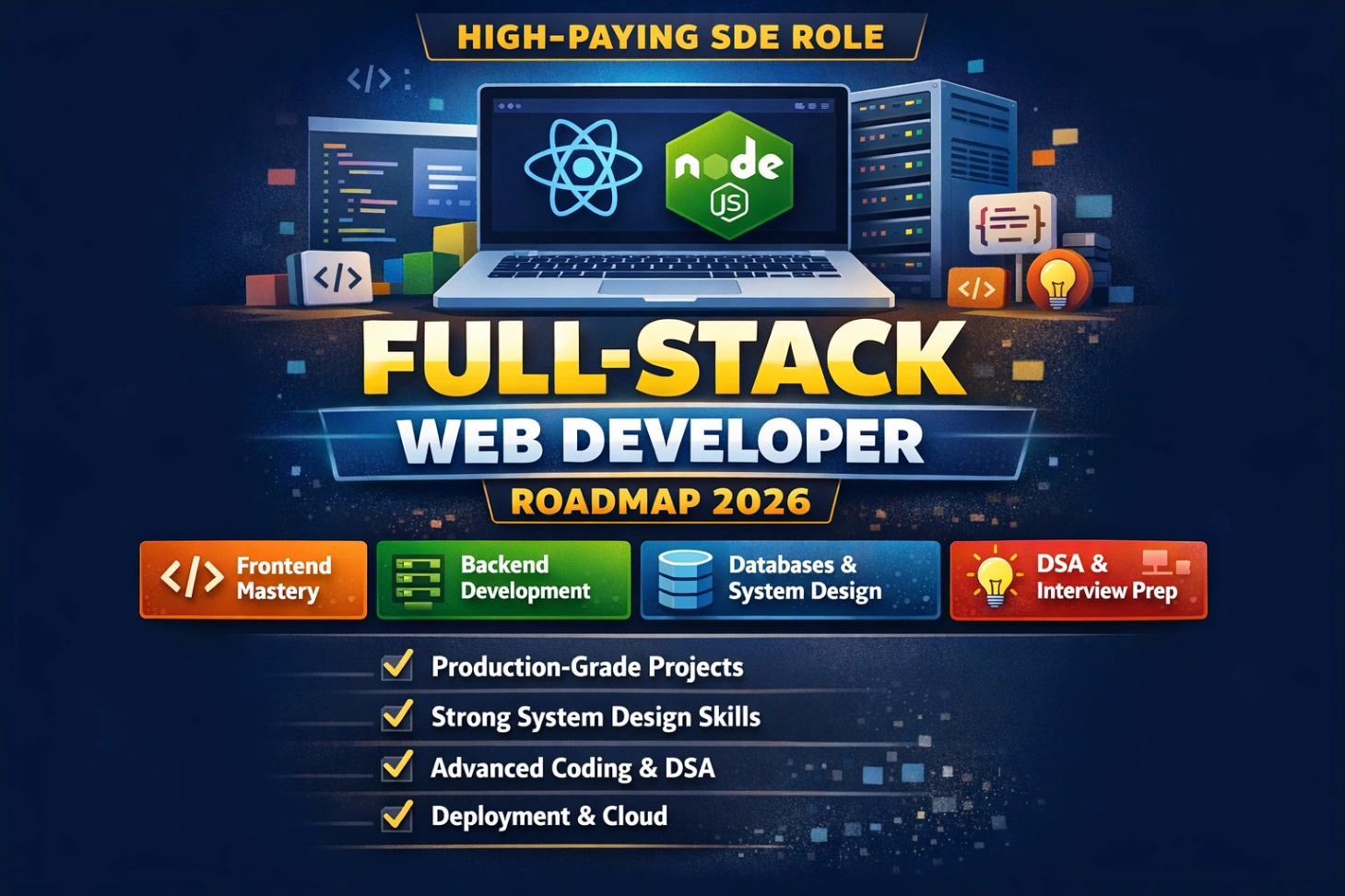
Full-Stack Web Developer Roadmap (2026)
Tech Stack Focus: React + Node.js + TypeScript + PostgreSQL
Goal: Crack high-paying product-based SDE roles with strong coding + system design + real production skills
PHASE 0 — Engineering Mindset (Week 0)
Most people skip this. Seniors don’t.
Learn
How the web actually works
Browser → DNS → CDN → Server → DB → Response
HTTP deep dive
Methods, headers, cookies, cache-control, CORS
REST vs GraphQL vs RPC (when to use what)
Client–Server responsibility boundaries
Must be able to explain:
“Where exactly does business logic live and why?”
PHASE 1 — Core Web + JavaScript Foundations (Weeks 1–4)
HTML (Not Optional)
Semantic HTML
Accessibility (ARIA roles, keyboard nav)
SEO basics
Forms, validations
CSS (Industry level)
Flexbox + Grid (master both)
Responsive layouts
CSS architecture (BEM / utility-first)
Animations & transitions
Tailwind and plain CSS understanding
JavaScript (Deep, not surface)
Execution model
Call stack
Event loop
Microtasks vs macrotasks
Scope, closures, hoisting
this, bind, call, applyImmutability
ES modules
Error handling patterns
Memory leaks (very important)
Async JavaScript
Promises internals
async/await
Parallel vs sequential execution
Retry logic
Timeout & cancellation (AbortController)
Git (Real usage)
Rebase vs merge
Cherry-pick
Resolve conflicts
Clean commit history
Deliverables
Responsive static website (deployed)
50–70 JS problems (no syntax lookup)
PHASE 2 — Advanced Frontend Engineering (Weeks 5–10)
React (How seniors use it)
Component design principles
Controlled vs uncontrolled components
Lifting state up
Composition > inheritance
Error boundaries
Code splitting & lazy loading
Hooks (Interview critical)
useState,useEffect(correct dependencies!)useMemo,useCallback(performance)useRefCustom hooks
Avoiding re-renders
State Management
Context API (when NOT to use it)
Redux Toolkit
Server state vs client state
React Query / TanStack Query (industry standard)
Routing
React Router
Protected routes
Lazy-loaded routes
Forms
Controlled forms
Validation strategies
React Hook Form + Zod
Frontend Performance
Memoization
Virtualization (lists)
Bundle size analysis
Lighthouse metrics
Frontend Security
XSS
CSRF
Token storage strategies
Projects
Job Tracker (filters, pagination, auth)
E-commerce UI (cart, search, debounce)
Analytics Dashboard (charts, tables)
Must explain:
“Why did you choose this state management approach?”
PHASE 3 — Backend Engineering (Node.js) (Weeks 11–16)
Node.js Fundamentals
Event-driven architecture
Non-blocking I/O
Streams
Worker threads
Express / Fastify
Middleware patterns
Centralized error handling
Request lifecycle
API versioning
Authentication & Authorization
JWT (access vs refresh tokens)
Session vs token-based auth
Password hashing (bcrypt)
Role-based access control
Validation & API Contracts
Zod / Joi
DTO patterns
Consistent error responses
File Handling
Uploads (Multer)
Cloud storage basics (S3 concepts)
Security (High-paying interviews test this)
Rate limiting
Helmet
CORS
Input sanitization
OWASP Top 10
Projects
Auth service
Blog / Notes API
E-commerce backend
Must explain:
“How do you secure APIs at scale?”
PHASE 4 — Databases & Data Modeling (Weeks 17–20)
SQL (Non-negotiable)
SELECT, JOINs, GROUP BY
Subqueries
Indexes (how they work internally)
Query plans (basic understanding)
PostgreSQL
Schema design
Normalization vs denormalization
Transactions
Isolation levels
ORM (Prisma)
Schema modeling
Migrations
Relations
N+1 problem
Caching
Redis basics
Read-through vs write-through
Cache invalidation strategies
Projects
Blog DB (users, posts, comments)
Invoice + payments system
Must explain:
“Why did you add this index?”
PHASE 5 — Production-Grade Full-Stack Projects (Weeks 21–28)
Mandatory Features
Authentication
Pagination
Search
Role-based access
Error handling
Loading states
Mobile responsiveness
Apps to Build
Job Tracker (Full Stack)
Team Collaboration App
E-commerce with Admin Panel
Production Add-ons
Jest (unit tests)
Integration tests
Swagger / OpenAPI
Logging (Winston/Pino)
Env configuration
Deployment
Docker basics
CI/CD concept
Cloud fundamentals (AWS/GCP/Vercel)
PHASE 6 — System Design (Weeks 29–34)
Core Concepts
Load balancers
Horizontal vs vertical scaling
Caching layers
Database sharding
Read replicas
Background jobs
Message queues (Redis/RabbitMQ)
Design Practice
URL shortener
Chat application
Job portal
E-commerce platform
Must explain:
Tradeoffs
Bottlenecks
Failure scenarios
PHASE 7 — DSA (Parallel: Weeks 1–34)
Focus Areas
Arrays, strings
Hash maps
Two pointers
Sliding window
Stack / queue
Binary search
Trees
Graphs
Dynamic programming (late)
Target
200+ problems
30–40 clean mediums
Medium solved in 30–40 minutes
PHASE 8 — Portfolio + Job Strategy (Weeks 32–36)
Portfolio
3 full-stack projects
2 frontend-heavy apps
1 backend-only API
Live demos + clean README
Resume
Metrics
Scale
Decisions
Impact
Job Strategy
Referrals > cold apply
Mock interviews weekly
System design practice verbally
What Actually Gets You High-Paying Jobs (2026)
✅ DSA + System Design
✅ Production-grade projects
✅ Ability to explain why, not just how
✅ Clean code + testing mindset
✅ Communication like a senior engineer
Comments (0)
No comments yet. Be the first to share your thoughts!
Leave a Comment
Get the latest updates
Join our newsletter and never miss an article.